

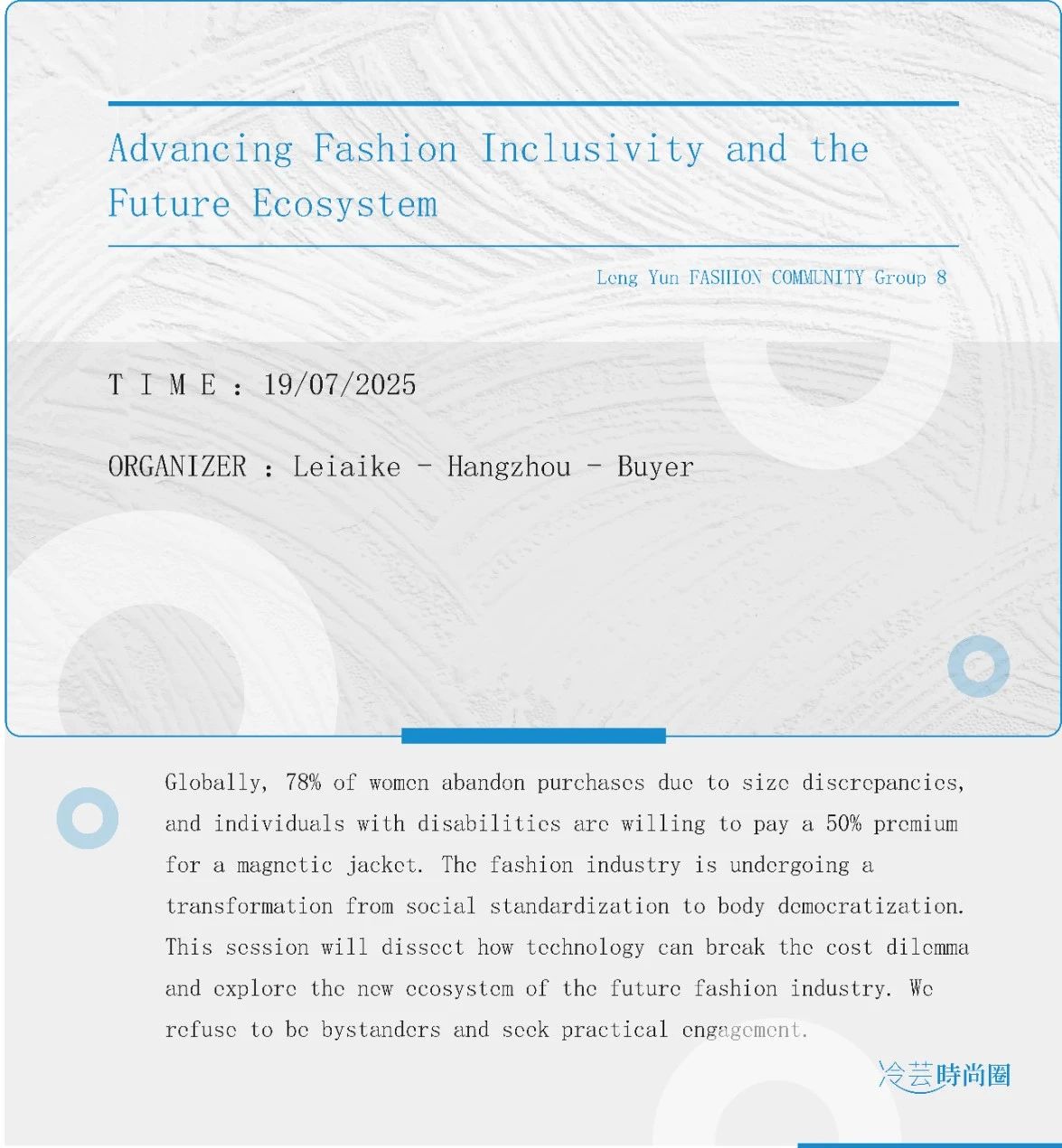
▼The following discussion in Leng Yun fashion community is a discussion and summary of industry issues. These shares are the crystallisation of collective wisdom. (They do not represent the personal views of Leng Yun). It is hoped that this method will benefit more industry professionals!

1. Current Market Situation
When discussing inclusive design in the plus-size clothing market, group member mentioned Jiangnan Buyi. This brand’s sizing can accommodate women weighing between 160 to 180 pounds. A plus-size female consumer working in the fashion industry stated that Jiangnan Buyi is almost her only option among retail brands, and she frequently purchases clothes from this label. This unique market position reflects the scarcity of physical stores offering plus-size women’s clothing. Faced with limited choices in brick-and-mortar shops, many plus-size consumers turn to online shopping. When selecting products, they pay special attention to brands that offer consistent styles, accurate sizing, and reliable design quality. Once they find a suitable brand, they often develop a purchasing habit, continuing to buy from the same place to improve shopping efficiency. As professionals in the fashion industry, their expectations for clothing go far beyond size alone; they would rather reduce the frequency of purchases than compromise on quality and design.
2. Design Concepts
In terms of design philosophy, Issey Miyake showcases innovative thinking regarding size inclusivity. Excellent designers generally emphasize that plus-size clothing design should not be confined to pursuing a “slimming” effect but should instead guide the formation of diverse aesthetic concepts. Interestingly, even public figures regarded as representatives of plus sizes, like Yang Tianzhen, face some criticism regarding their fashion taste from other women, reflecting the higher expectations the plus-size community has for fashion expression. Social media platforms have seen brave plus-size fashion influencers who actively discuss brand size-friendliness in their circles and confront others’ comments about body types. Some individuals even overcome personal barriers to walk the runway or participate in fashion advertisements. These actions not only demonstrate the pursuit of fashion within the plus-size community but also emphasize the importance of self-awareness over external evaluations.
3. Market Conditions
The current market shows a clear mismatch between supply and demand: some consumers suppress their shopping needs due to body image anxiety, leading to those who genuinely need clothing being unable to find suitable products; meanwhile, consumers aligning with mainstream beauty standards face an overwhelming number of choices. This phenomenon partly stems from the mainstream media’s advocacy for the “white, young, and thin” aesthetic and fitness-oriented elements, which, to some extent, exclude the consumption needs of the plus-size group. From a health perspective, experts stress that body size itself is not an issue as long as it does not affect physical health. The focus should be on BMI exceeding the recommended range, which is a separate discussion from aesthetic standards. Moreover, human perception of beauty often arises from instinctive intuition, and this intuitive judgment is not necessarily tied to moral assessments. Leng Yun, in her book “Philosophy of Dressing,” presents an important viewpoint: resolving dressing issues begins with addressing self-awareness problems. One must correctly evaluate their age, body shape, and appearance in order to choose the right clothes for themselves.

1. Analysis from a Business Perspective
From a commercial perspective, the success of popular products often lies in their inclusive characteristics that do not discriminate based on body type or age. However, many brands fail to directly address this point and instead overemphasize brand tone and trendy elements. Some brands choose to establish dedicated plus-size sub-brands, separating plus-size products from regular sizes. Changing this non-inclusive status quo requires multi-faceted collaboration: influencers (KOLs) and mainstream media need to continuously advocate for change, similar to how they promote sustainable fashion; brands must maintain innovation in design and offer more inclusive products; and consumers need to develop healthy self-awareness.
As industry insiders have pointed out, if clothing can come in various colors and styles, why can’t sizing be more inclusive? This question not only pertains to design thinking but also represents a deeper issue that the entire industry needs to confront seriously. However, such change may take five, ten, or even twenty years, but it is an issue that the fashion industry must face and resolve.
So, what are the specific requirements that plus-size women have for clothing? Key design points include armhole size, skirt volume, and waist and abdomen details, which need to enhance mobility while maintaining mainstream aesthetics. The future direction of clothing design should blur the concept of sizing, allowing individual garments to accommodate different body types rather than restricting consumers to a specific weight range. This inclusive design can not only address inventory issues but also meet a broader range of consumer demands. Comfort and appropriateness form the two core pillars of this design philosophy.
2. Technological Innovation
Technological innovation has become a key driving force for industry development. International designers have developed clothing and footwear products that utilize elastic sizing, a technology that requires specialized copyright authorization for usage. In contrast, innovation within the domestic clothing industry primarily focuses on fabric technology. Many private label companies establish competitive advantages by mastering fabric sourcing, enabling them to create fabrics with different properties using the same type of yarn. However, there is still considerable room for improvement in innovative silhouettes and pattern structures within domestic enterprises.
Emerging Characteristics in Brand Selection. Brands like COS, AUM, and LESS, while not specialized plus-size brands, offer certain styles that cater to consumers with higher BMI values. These brands typically provide only two to three sizes but utilize clever design to enhance the inclusivity of their garments. Marketing strategies also need to break away from traditional thinking. Plus-size consumers pay special attention to prominent plus-size influencers and celebrities with striking looks and avant-garde concepts, expecting to see marketing content that emphasizes female subjectivity and aesthetic diversity.
Some successful marketing cases showcase models of different body types wearing the same garment, maintaining a sense of fashion in styling and photography that highlights individuality while emphasizing practicality. However, these models often have relatively proportionate figures, which visually do not appear plus-size.
The current state of the entertainment industry reflects deeper societal perceptions. Even former plus-size representative Yang Tianzhen has lost weight, which is related to her profession—the lens magnifies body size. In both domestic and international entertainment circles, maintaining a healthy body type has become a basic professional requirement and is often included in contract stipulations. Particularly abroad, a good physique is seen as a symbol of self-discipline and serves as a distinguishing marker of social class. Therefore, Yang Tianzhen’s weight loss does not imply that all plus-size women must follow suit. As long as it does not affect health, body size should not be an issue.
True confidence should not depend on external influences, and the development direction of plus-size clothing should not be limited to simply expanding size ranges. Instead, it should achieve genuine inclusivity at both the design and marketing levels.
From a business perspective, developing clothing suitable for different body types can not only resolve inventory issues but also open up broader market spaces. This requires continuous innovation in areas such as fabric technology and pattern structure, while simultaneously showcasing diverse aesthetic values in marketing communications. This inclusive design philosophy is gradually becoming a new driving force for industry development.
PS:The translation is done by AIGC

 CHINA FASHION BUSINESS
Leave a comment