
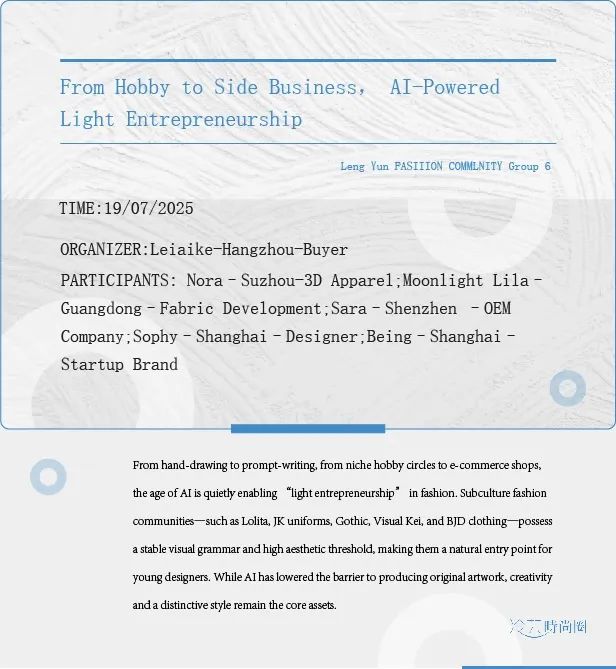
▼The following discussion in Leng Yun fashion community is a discussion and summary of industry issues. These shares are the crystallisation of collective wisdom. (They do not represent the personal views of Leng Yun). It is hoped that this method will benefit more industry professionals!

Certain fashion subcultures exhibit strong community characteristics. From Lolita, Hanfu, and JK uniforms to doll clothing, as well as styles such as “Minefield Kei,” “Pure Kei,” and “Mass Production Type,” many have formed circle cultures centered around influential “recommenders” or “mentors.”
An industry veteran with over a decade in the BJD (ball-jointed doll) field observed that when BJD was still niche, identifying a few leading figures could significantly drive sales. Aesthetic preferences across related circles meant that products with certain signature features sold particularly well.
For new designers, entering the market with products that carry recognizable, iconic features is an effective strategy. For example, Lolita’s first impression is often a puffed skirt adorned with decorative bows, or Gothic styles filled with studs and skull prints; doll clothing might be a frilly maid dress for girls or a sharp suit for boys. These classics remain popular—especially among newcomers on the periphery of the circle, who tend to choose such signature entry-level pieces.
In product innovation, adding new elements to classic designs can increase distinctiveness. For instance, incorporating Halloween themes into the traditional bow-adorned puffed skirt—creating witch or vampire motifs, or using pumpkin tones. Designers are increasingly using AI tools to support creation, from designing prints to producing garment renderings, with tools such as Look APP, Midjourney, and Leonardo AI being widely adopted.

1. Subculture Apparel Market Overview
While AI design is convenient, it also faces challenges in structural feasibility. This is not only a limitation of AI but also a common issue for self-taught designers—focusing too much on visual appeal while overlooking practical execution. However, when working from classic templates and layering new elements, AI remains an efficient design assistant.
The BJD apparel market includes several major categories: Lolita, street fashion, Western fantasy, and Chinese traditional costume. These special garments are mainly for photography; high-end gowns see limited real-life use, aside from events such as fashion weeks, company parties, and weddings. Within the female BJD circle, Pink House style, Lolita, maid outfits, and miniature European gowns remain consistently popular.
The high-end market has seen BJD gowns auctioned for over RMB 100,000, often featuring intricate hand-beading, embroidery, and other techniques—serving primarily as showcases of a designer’s craftsmanship. While profitable, such haute couture production demands exceptional technical skill, making it more suitable for experienced pattern makers. For newcomers, showcasing work on platforms like Xiaohongshu, starting with basic pieces, is advisable. If photos are strong, producing a few premium sets can allow for gradual price increases.
2.AI Visual Workflow Breakdown
The BJD and doll clothing market shows remarkable spending power, with some collectors willing to spend RMB 200,000 on doll outfits. In the Blythe doll market, complete customization can cost tens of thousands of yuan, and China’s top Blythe customizers reportedly only take commissions from affluent clients and celebrities.
For designers entering this market, it is recommended to start by purchasing mid-range Japanese dolls and integrating into the community by sharing the production process on social media.
Copyright issues require caution—especially when replicating human clothing styles, where authorization is preferred. Designers should analyze why certain styles are trending, considering factors such as price, aesthetic trends, and product features. For those with strong handcrafting skills who are willing to invest significant time, this market holds substantial potential. Consistently showcasing the making process is key to building a personal brand.
This niche also values craftsmanship highly; some works rival full-scale gowns in complexity. For example, a designer once spent a month creating a rock-style studded outfit for a pet—this dedication reflects the essence of circle culture. Sales channels are mainly auction-based, such as on Xianyu, where high-quality production and photography greatly enhance product value.
3. Light Entrepreneurship Case Studies
After decades of growth, the BJD market has become highly developed, with clear segmentation among users. Compared with ten years ago, entry-level BJD prices have become more accessible, allowing primary and middle school students to start with products costing only a few dozen yuan.
At the same time, core collectors continue to seek higher-end products, creating a distinct consumption hierarchy. At DP (Doll Party) events, some high school players own at least five dolls priced over RMB 4,000 each, purchase 1/6-scale dolls at RMB 1,500, and buy matching clothes, eyes, and accessories.
For entrepreneurs entering the BJD market, selecting the right product positioning is critical. A safe starting point is Volks dolls—SDGR series for 1/3 scale and MDD series for 1/4 scale. As the participant base grows, high-end consumers will continue to drive demand for more unique, high-quality products, pushing the market toward greater specialization.
The Labubu doll market has recently surged, though with significant polarization. At Yiwu wholesale markets, some products cost only a few yuan, while genuine Labubu dolls still have over one million pending orders. This demand has led some children’s clothing factories to pivot to Labubu apparel production. However, counterfeiting has emerged, with reports of illegal producers being prosecuted.
AI technology is reshaping traditional doll clothing design workflows. Some teams have developed AI models specifically for BJD and Labubu clothing and plan to launch one-click pattern-generation features. This technology has already attracted attention from Wuhan’s Hanzheng Street apparel supply chain, Hanpai fashion brands, and even textile university professors considering it as a research topic. While general tools such as Doubao and Midjourney exist, specialized models tailored to niche markets often produce more relevant results.

1. Why “AI Gets You There Fast, the Circle Gets You There Far”
In practice, caution is advised when using AI-generated images. Avoid posting raw AI outputs directly on platforms like Xiaohongshu, as structural inaccuracies can harm professional credibility. A better approach is to use AI for creative sketches, then produce pattern breakdowns and conduct market research.
Notably, under domestic regulations, AI images generated from text prompts are considered original works, while those generated from existing images are not recognized as such.
Doll clothing prices vary widely—from a few dozen yuan for basic styles to RMB 400–500 for refined designs, with factory processing fees around RMB 150. Japanese high-end brands can sell for RMB 2,000–3,000; in China, this price range is typically limited to PH style and vintage reproductions. Despite their small size, doll clothes are often harder to make than human garments, with craftsmanship comparable to RMB 2,000–4,000 womenswear. The precision required makes many workers unwilling to take on such labor-intensive orders.
2. Design Is Never an Island: Finding Your Like-Minded Community Is Your Greatest Asset
Marketing strategies should match product positioning. High-end products require original photoshoots, while mid-to-low-end products can collaborate with in-circle KOLs (known as “mentors”), with photoshoot fees typically ranging from RMB 200–500—much lower than the four-digit rates charged by human influencers.
Offline channels, such as Guangzhou’s Comic Star City, price doll clothing from RMB 500 upward—higher than online—but offer hairdressing, makeup, and in-person photoshoots as added value.
Entrepreneurs should assess their accessible supply chain before determining product tier. For intricate vintage-style garments, creating a physical sample is recommended to showcase technical skill. On social media, sharing the entire process—from AI-assisted design to final production—can help build a client base.
Importantly, avoid producing counterfeit luxury styles due to intellectual property risks. Originality is highly valued in the doll community; brand reputation must be built on continuous innovation and high craftsmanship. This market’s growth potential is strong, with both offline stores and online communities thriving. In recent years, Shenzhen has also seen dedicated doll clothing shops offering accessories and specialized services.
 CHINA FASHION BUSINESS
Leave a comment