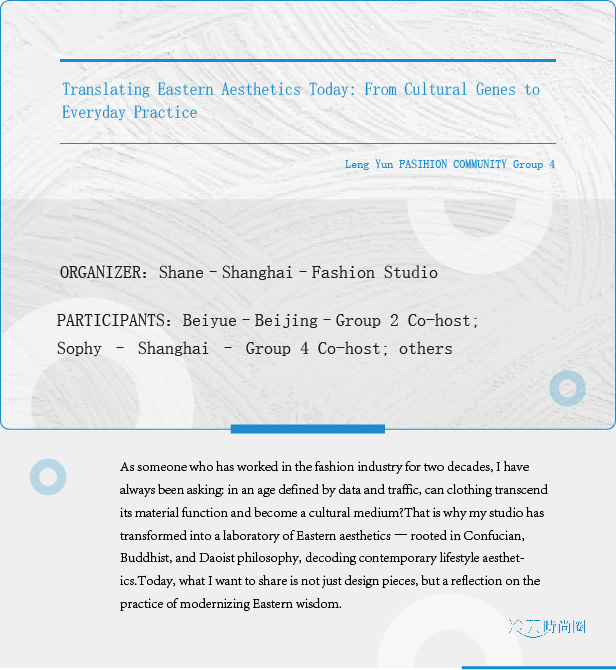

▼The following discussion in Leng Yun fashion community is a discussion and summary of industry issues. These shares are the crystallisation of collective wisdom. (They do not represent the personal views of Leng Yun). It is hoped that this method will benefit more industry professionals!

1. Responding to Contemporary Anxiety with Eastern Wisdom
Modern fashion design faces a fundamental choice: should clothing be defined merely as a commodity, or should it return to its essence as a cultural medium? Many designers prioritize market acceptance and sales potential when creating. Yet another perspective holds that clothing should first and foremost center on the experience of wearing.
2. Why Use Eastern Philosophy to Decode Modern Life?
Compared with purely commercial concerns, cultural symbols and aesthetic expression play an increasingly important role in fashion design.
Take this new collection as an example: a dress, a coat, and a camisole, made from a blend of linen and silk. The coat features lantern sleeves. Strictly speaking, this is not a traditional suit—it has no pockets, uses a Daoist robe collar, and carries the volume of lantern sleeves.
The dress is designed with wearability in mind, featuring a waist tie that can be adjusted to fit different body shapes. In fact, ties were mainstream in traditional Chinese dress, while the so-called “iconic” frog buttons were historically only a secondary element. Such design choices are based on research into historical garments, with designers consulting ancient sources—for example, Tang dynasty clothing displayed at the Fengxian Museum.


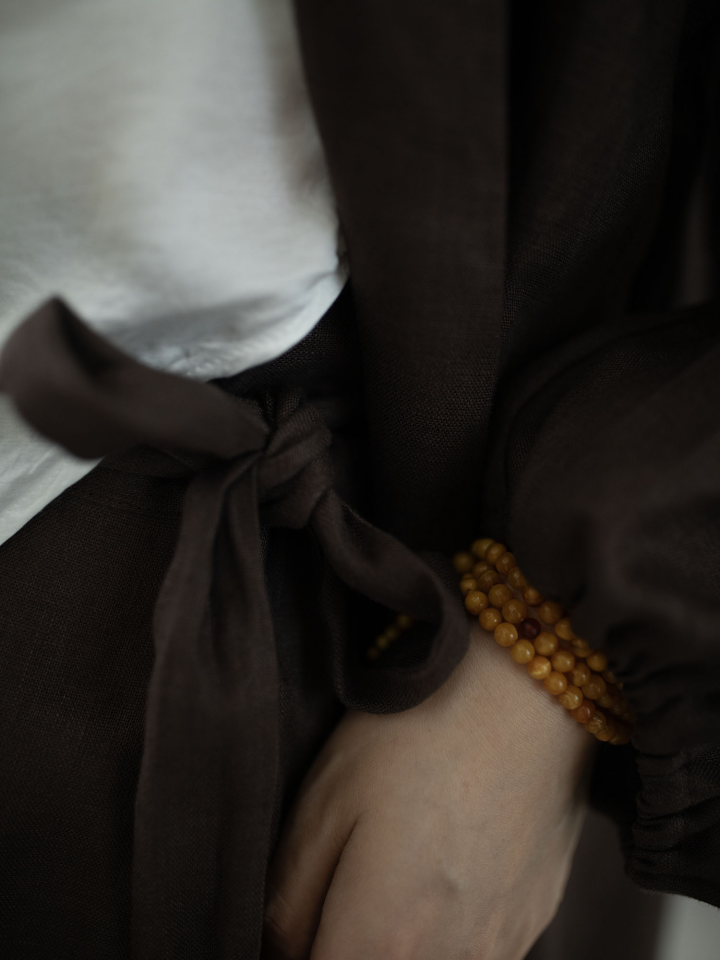
As for the origins of the Daoist robe collar, Song dynasty beizi are said to have been influenced by Daoist robes. One-piece skirts were also an important form in traditional dress, and many contemporary designers are experimenting with tied one-piece garments. Yet in practice, market concerns remain unavoidable, often limiting how fully these ideas can be realized.
3. The Core Appeal of Chinese Design
If we set aside sales pressure, what kind of Chinese-style garments do people truly want to wear? Is it pieces with frog buttons and qipao collars, or designs with ties and mandarin collars?
Preferences differ. Some prefer linen for its comfort, others see Song-style clothing as more suitable for daily wear. When it comes to the appeal of Chinese design, loose silhouettes are often highlighted, as they allow for versatile reinterpretation. Evoking a poetic atmosphere is also key. Color, pattern, and silhouette together form the core of Chinese design—creating an artistic mood while still integrating a sense of sophistication and modernity.
Patterns are a defining feature of Chinese design, rich in symbolic meaning. Gourds represent blessings and prosperity, peaches symbolize longevity, and deer carry multiple connotations: good fortune, elegance, beauty, and long life. In certain contexts, deer also signify power. These motifs embody the traditional Chinese belief that “meaning must be auspicious.”
At its heart, Chinese clothing culture values what it conveys. Chinese aesthetics prioritize yi (meaning), where atmosphere outweighs form. From this perspective, engaging with Confucianism, Buddhism, and Daoism is essential for anyone seeking to design within the framework of Eastern aesthetics.
4. Three Pathways for Translating Eastern Aesthetics into Design
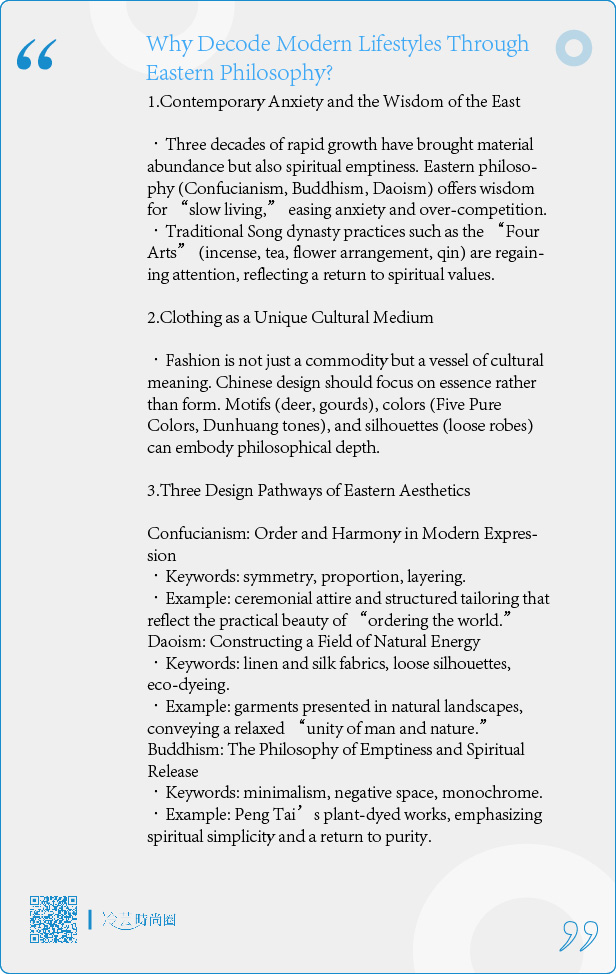
Eastern aesthetics can be translated into modern design through three main paths: Confucianism as an interpretation of the beauty of order, Daoism as the construction of natural energy fields, and Buddhism as the practice of spiritual detachment.
These ideas become design languages: Confucianism translates into a sense of ritual, Daoism into natural comfort and relaxation, and Buddhism into minimalism and detachment. For example, Daoist-inspired designs often use linen fabrics to express simplicity and nature.
It is worth noting that designers themselves may not practice these philosophies, yet Chinese life and aesthetics remain deeply shaped by them. Historically, Confucianism dominated before the Wei and Jin dynasties; Buddhism gained influence thereafter; and Daoism flourished after the Northern Song. White often evokes Buddhist purity. Still, translating such ideas into design remains a challenge. At times, the connection to Chinese culture may not be obvious, requiring additional means of expression.
5. Design Strategies for Different Market Segments
For the public market, design strategies must be more direct and concrete.
Some brands have experimented with denim-based “new Chinese” garments, aiming to bring Chinese culture into everyday consumer choices rather than confining it to expensive couture or brocade pieces. They even created subway styling videos to show Chinese-style clothing in daily settings.
In public markets, expression can be diverse, but clarity is key. Pricing must be accessible; once consumers understand the design’s meaning and find the price reasonable, their purchase decisions become easier.
One idea raised was filming short stories about customers and their connection with the brand’s clothing, creating emotional resonance. Yet cost must be considered. The key difference between public and private markets is that the former requires clear, thematic storytelling with strong connections.
By contrast, niche brands targeting private markets can charge higher prices. Their visuals are often shot in a documentary style, featuring studio members or real clients. If the brand identity centers on relaxation, videos capture everyday moments of leisure. With careful editing and modest budgets, these projects provide tangible experiences that make product quality and brand philosophy feel authentic.
In private markets, some brands like Husheng Yimu (HSYiM) have performed well in both form and feel. Their garments are distinctive, with designs that speak clearly. Traditional fabrics such as silk, ramie, and gauze remain useful for conveying yi. Brands like Nagqu produce high-quality fabrics while modernizing silhouettes in ways that don’t appear dated.
Expressing design concepts is never simple. Chinese culture is a vast treasury of dynastic themes, myths, and legends. Yet applying these thoughtfully is not easy. People struggle to imagine what they’ve never seen, raising the bar for innovation. Some design philosophies focus on the overall feeling a piece conveys rather than piling on detail. Excessive detail can distract from the intended mood. For example, when inspired by Daoism’s harmony between humanity and nature, the goal is achieved if viewers feel relaxed and at ease.

1. Avoiding Stereotypes in Eastern Elements
Eastern aesthetics can be reinterpreted through three primary paths: Confucian order, Daoist natural energy, and Buddhist emptiness. Together, these provide rich theoretical and creative foundations for new Chinese design.
In practice—whether editing videos or designing clothing—maintaining a natural, effortless approach often produces better results. Overly contrived work risks losing the spontaneity valued in Eastern aesthetics.
As mentioned earlier, elements like Song-style garments or frog buttons are frequently overused. Designers and even decision-makers often fall back on these clichés. But what makes French design distinctly “French”? Some might say polka dots. Yet French design is more about freedom, chicness, and avant-garde spirit—qualities that continue to lead global fashion.
2. Innovation Pathways in Chinese Design
If we take French or Japanese design as reference points, Chinese design can avoid stereotypes simply by developing its own identity. Possible entry points for embedding Eastern elements include silhouette, color, and fabric.
Silhouette: traditional dynastic garments, wide Daoist robes, and Buddhist monk’s wear all contribute to the “loose garment culture.” With oversized, unstructured, straight-line tailoring, this two-dimensional approach is a defining resource.
Color: both solid and patterned. Examples include the Five Traditional Colors, Dunhuang-inspired palettes, and shades drawn from the Forbidden City. Popular tones like sky blue or Chinese red also apply. Patterns may reference motifs, Chinese painting, or other sources.
Fabric: Chinese specialties such as mulberry silk, ramie, linen, cotton, xiangyunsha silk, and gauze all hold cultural depth.
Craftsmanship: historical methods such as kesi silk weaving, gold brocade, and various embroidery techniques offer potential. Many luxury brands already use kesi or gold weaving to elevate value. Techniques like tie-dye and batik are also widely associated with China. For example, Taiwanese designer DAI Zhi-Cheng experiments with fabric treatments using herbal plants, boiling, dyeing, and weathering to express the aura of Chinese mountains and forests. Plant dyeing can indeed achieve highly poetic results.
3. Building New Models for Cultural Premium
When it comes to raising product premiums, tie-dye and batik are less effective today due to market saturation. In fact, almost anyone can attempt basic plant dyeing or leaf printing, though true color fixation is complex. Many tourist shops sell “hand-dyed” items with minimal craftsmanship.(Note: This was the host’s personal view. In reality, authentic plant dyeing is highly skilled; some merchants merely exploit it as a gimmick.)
A more direct way to build cultural premium is to target high-spending consumer groups. Those with limited purchasing power tend to prioritize cost-effectiveness and will not pay extra for “cultural value.”Cultural premium depends on building recognition: when buyers resonate with a cultural narrative, they also accept its added value.
PS:Translation is done by AI.
 CHINA FASHION BUSINESS
Leave a comment