
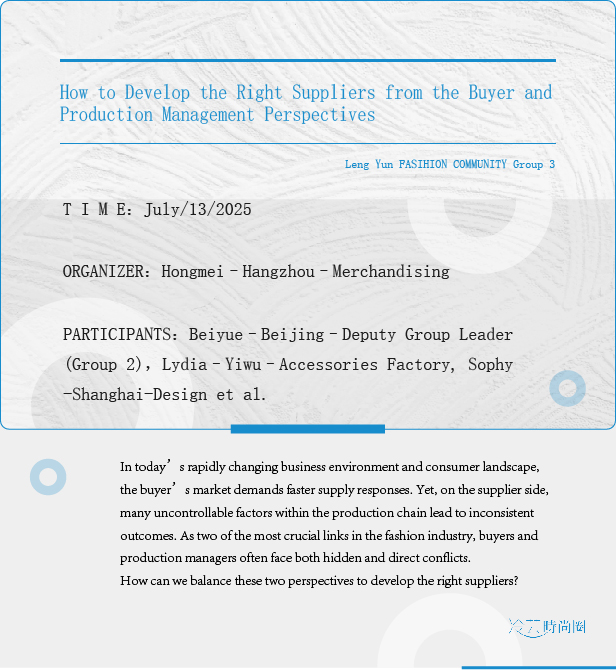
▼The following discussion in Leng Yun fashion community is a discussion and summary of industry issues. These shares are the crystallisation of collective wisdom. (They do not represent the personal views of Leng Yun). It is hoped that this method will benefit more industry professionals!

1. Challenges Faced by Buyers and Manufacturers
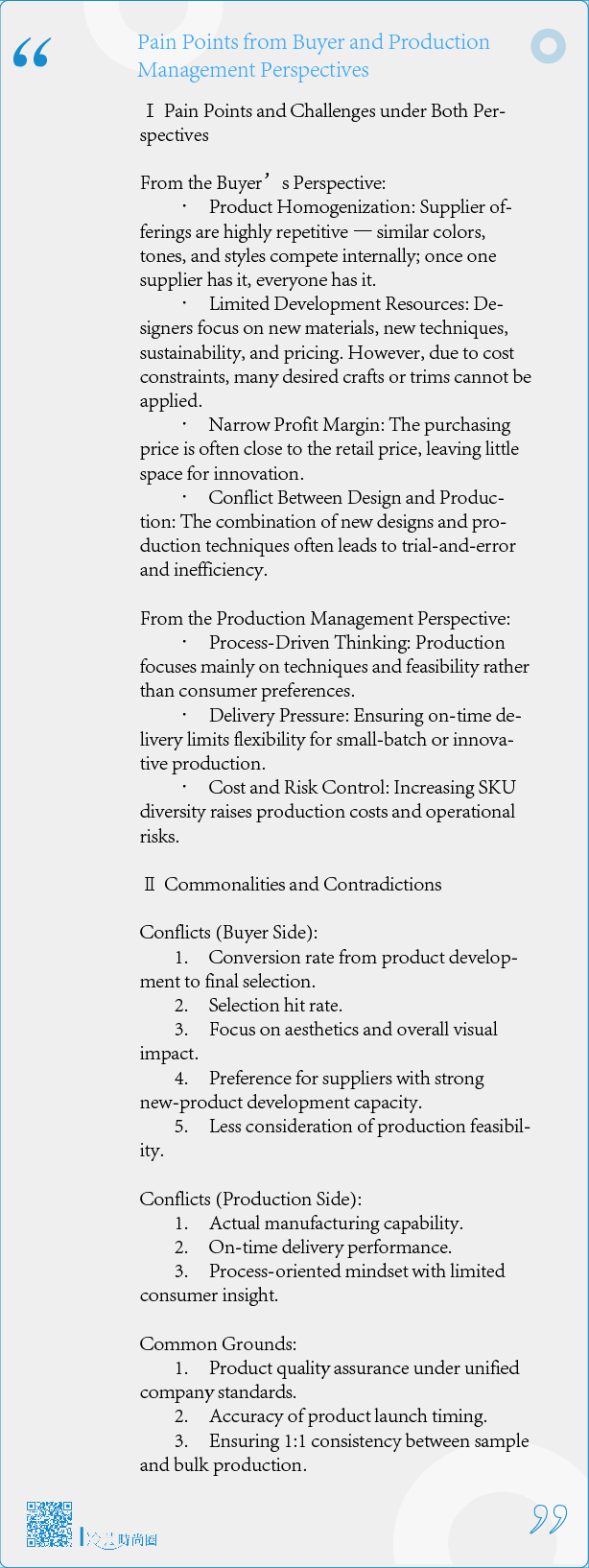
From the factory’s perspective, it takes significant time and effort to align new designs with production techniques. The sampling and trial stage is a long and tedious process.
From the designer’s viewpoint, fabric selection often focuses on new materials, new processes, sustainability, and pricing factors. However, the purchasing price of newly developed products is often nearly the same as existing ones, while the buyer side (Party A) fails to consider the additional R&D cost involved in developing something new. This creates a paradox for the factory.
From the buyer’s perspective, supplier products are highly homogeneous — color tones and palettes often remain the same season after season. Buyers expect innovative materials and designs, but most ODM suppliers make little change between seasons.
This homogenization in the market is severe, leading to a situation where no one makes a real profit, and consequently, fewer parties are willing to invest in innovation. These are common challenges across the industry.
2. Differentiated Product Development Strategies
In addition to producing consistent classic styles, buyers expect suppliers to deliver more differentiated products. However, this creates another problem — it raises the bar for suppliers. Buyers must constantly look for new suppliers, which costs both time and resources. Meanwhile, retail prices can’t be increased easily, creating a true dilemma.
1. Factories with ODM Advantages
Factories with their own design departments can develop products tailored to each client’s preferences and target price point. Since production and design are integrated, these suppliers can more effectively realize buyer-side needs.
2. Brand Provides Concepts; Factory Delivers Technical Realization
Most brands purchase finished goods. From the factory’s perspective, the goal is to secure orders from buyers and convert samples into bulk production. Therefore, factories always hope for long-term partnerships with buyers.
If the buyer (Party A) has its own R&D department, it can provide product concepts and design drafts for the factory (Party B) to prototype into finished goods.
3. Supplier Profiles that Fit Buyer Needs
What kind of supplier is truly suitable? The ideal partnership is mutually beneficial, “well-matched,” and built on trust. Service, product quality, delivery, and qualifications are all essential.
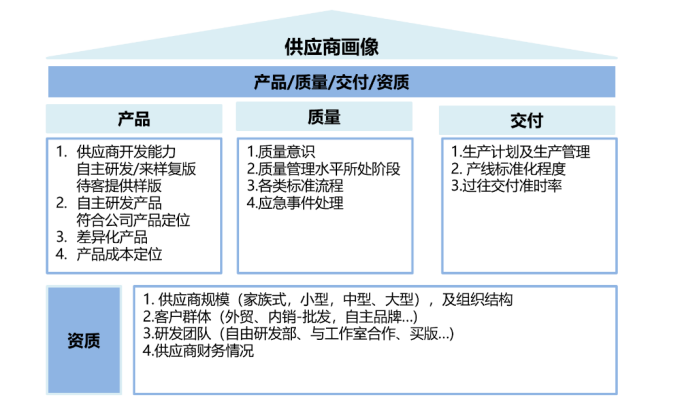
Many of us in the industry share the same feeling — while the number of suppliers is large, it often feels like something is still missing, though we can’t quite pinpoint what. The buyer wants it all — “this, that, and more” — but such demands are rarely met fully. One practical approach is to rate suppliers across key dimensions to support better decision-making.
“Balancing needs” generally refers to how to resolve and adjust when existing suppliers fail to meet product requirements.

In product and supplier development, it’s common to perform risk assessments, especially for new fabrics and production techniques.
For fabric-based products, quality testing typically follows national standards and third-party inspections for physical and chemical performance. Consumers, however, care most about issues such as shedding, pilling, and color fading. Product fit, craftsmanship, and wearing effect also play roles in evaluation.
New materials often present the highest risk — for example, bonded lingerie fabrics can face delamination issues.
Risk assessment should be conducted before cooperation even begins, taking into account price and other risk factors at every stage. Many fabric suppliers are hesitant to push new materials precisely because development is costly and the failure rate is high. If testing reveals issues, the decision becomes whether to proceed or abandon.
This belongs to product pre-production quality risk control, not partnership risk evaluation — it occurs before mass production.

PS:Translation is done by AI.
 CHINA FASHION BUSINESS
Leave a comment