

▼The following discussion in Leng Yun fashion community is a discussion and summary of industry issues. These shares are the crystallisation of collective wisdom. (They do not represent the personal views of Leng Yun). It is hoped that this method will benefit more industry professionals!

1. The coexistence of essential needs and emotional needs
Fragrance penetration in China remains low—only around 5%, compared with over 40% in Western countries. This means the fragrance market is still on an upward track. New brands and companies continue to grow rapidly every year, but this speed must match the growth of consumer demand. It is an industry that requires long-term consumer education.
In the context of an economic downturn, perfume and home fragrance display a typical “lipstick effect.” Traditional beauty giants have rushed into the fragrance market, and even long-established Chinese beauty brands such as Maogeping, Banu Huadian, and Pechoin are launching perfumes. Everyone sees the potential of this track. When the economy is down, emotional consumption becomes more universal—but lipstick, once the symbol of emotional spending, has been replaced by a wider range of emotional-value products.
Thus, perfume and home fragrance are essentially a fusion of functional necessity and emotional appeal.
2. Features and trends of essential vs. emotional consumption
Car fragrances, for example, are originally a functional essential. Years ago, they came only in a few basic scents like floral or cologne. Today, both design and scent varieties have become more diverse, aiming to catch the consumer’s attention and tell emotional stories.
Categories with stronger essential attributes—such as car fragrance, air fresheners, and personal care fragrance—tend to be highly functional, have a large consumer base, lower spending thresholds, and mainly follow a value-for-money route. In contrast, categories with stronger emotional attributes—perfumes, diffusers, candles, scented accessories—have smaller consumer bases, require education, feature intense brand competition, have wide price ranges, and support higher price ceilings.
City differences also influence fragrance consumption. In Ningbo, essential-need consumption is strong, but non-essential categories like fragrance are relatively weak. Shanghai, influenced more heavily by Western lifestyles, has a strong fragrance culture and high public acceptance.

The main weaknesses of offline stores lie in lower brand recognition and weaker price competitiveness. However, their strengths are equally clear—offline stores offer real sensory experiences and service, which online shopping cannot provide.
Online operations follow the logic of “visual first,” using visuals, copywriting, and video to seize consumer attention while lowering purchase barriers through trial-kit sets. Combined with social media and influencer marketing, online channels excel at “planting seeds.” These characteristics, together with the overall growth of the fragrance market, create significant challenges for offline stores compared with online models.
Several fragrance brand founders known by the host perform well online but have struggled to achieve the same results in offline expansion over the past two years—even after investing in brand image and experiential upgrades.
The host’s three stores also operate at an average level. The main issue is poor site selection and weak foot traffic. However, because she focuses heavily on service and product strength, one of her stores achieved “Gold Store” status and ranked No.1 locally in the DIY hand-craft category within just nine months of opening.
In lower-tier cities, fragrance stores can be profitable, but only with very high requirements for site selection and operations. If site selection cannot be changed in the short term, the store must rely on strengthening operations—excellent service, offline experience, and funneling online traffic into offline visits.

1. Multi-layered construction of store image, product offering, service, and channels
First, the store’s aesthetic and product lineup must be strong. Serve every customer well and expand B-end channels.
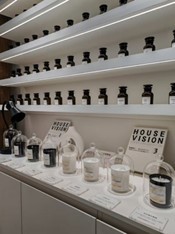
Store image also needs memorable elements. A relaxing and healing atmosphere can be created. The host shared an example: a unique shop in Shengzhou located within a heritage building, with an open interior and a north-facing floor-to-ceiling window that blends classical and modern moods. Small interior setups enhance a calming atmosphere. She also places personal book collections in corners to add warmth—customers enjoy browsing even if they don’t buy.
Because of budget limitations, she placed only five or six faux-plant floor pieces and smaller tabletop decorations. However, adding greenery is highly effective for attracting foot traffic.

2. A complete product structure balancing essential and emotional categories, plus personalized customization
Because her agency brand lacked strong car-fragrance products—while customer demand was high—the host brought in other car-fragrance brands. Because the agency’s perfume lineup lacked strong visual appeal and richness, she introduced additional fragrances with stronger design and texture, evolving toward a multi-brand collection-store model. Proper brand selection and product-mix balance significantly improve conversion rates and overall sales.
Fragrance naturally aligns with customization and personalization, so expanding DIY offerings is also effective. Beyond perfume-blending DIY, categories can extend to traditional sachets, essential-oil soaps, essential-oil candles, etc., strengthening customer acquisition and boosting repeat visits and repurchases.
DIY requires guidance and clean-up, so pricing cannot be too low. It is a sub-category worth refining: high margins, boosts store ratings through group-purchase listings, fills slow hours, provides strong interaction and emotional value, creates content ideal for social-media sharing, and helps channel online traffic offline.
3. Strengthening service details to deliver emotional value and enhance stickiness
Because store foot traffic is limited, staff treasure each visitor—from reception, to product introduction, to after-sales service. For after-sales, they invite customers to add the store on WeChat and follow through on usage issues or quality concerns, so most customers willingly connect. This builds a private-domain ecosystem and creates deeper long-term relationships.
4. C-end private-domain maintenance and B-end expansion
C-side private-domain operations are still in a foundational stage, mainly focusing on after-sales care and holiday greetings, which already drive WeChat repurchases. Further refinement is planned.
On the B side, they seek corporate bulk orders, holiday events, and projects via malls and street districts. For example, two weeks ago, she created a fragrance installation for a designer hotel’s lobby, featuring essential-oil aromatherapy. Further collaboration on guest-room amenities is in negotiation.

PS:Translation is done by AI.
文字整理:周麟茜
文字编辑:周麟茜
美术编辑:李宁
 CHINA FASHION BUSINESS
Leave a comment