
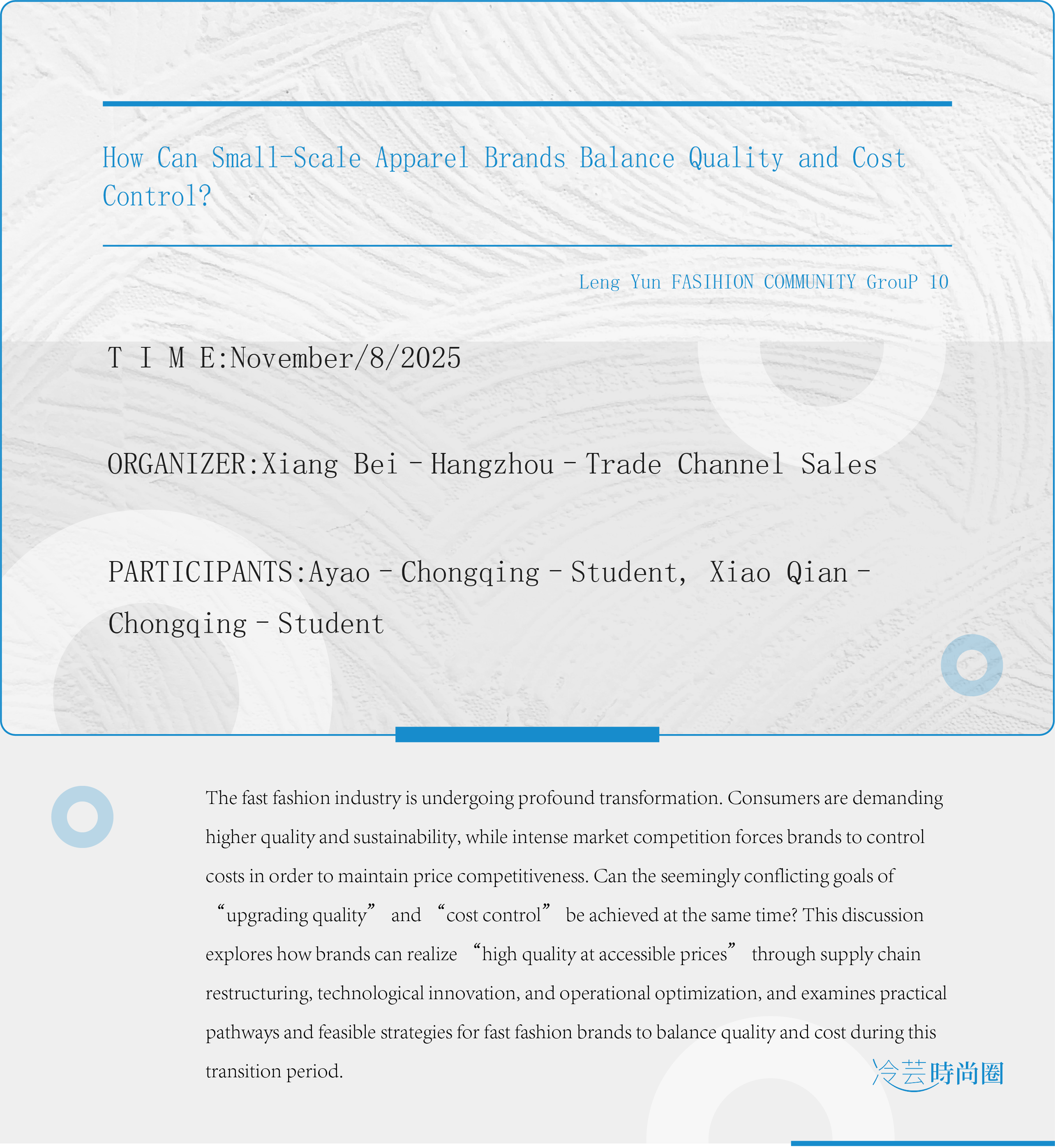
▼The following discussion in Leng Yun fashion community is a discussion and summary of industry issues. These shares are the crystallisation of collective wisdom. (They do not represent the personal views of Leng Yun). It is hoped that this method will benefit more industry professionals!

1. Quality Upgrading as a Necessity for Brand Survival
Consumers are increasingly demanding durability and eco-friendly materials, and Gen Z is willing to pay a reasonable premium for higher quality.
When choosing clothing, consumers not only care about whether the style suits them, but also consider usage scenarios, price, fabric texture, brand, and workmanship. In recent years, the rapid spread of “best-seller” styles has led many manufacturers to produce similar designs, making differences in fabric and craftsmanship more important in comparison. Moreover, many apparel brands—especially outdoor brands—actively promote functional fabrics, which has raised consumer awareness of fabric performance.
If you see two similar styles on Taobao and notice quality differences (fabric and workmanship) through buyer review photos, how much premium would you be willing to pay for the better-quality option?
A. 10%–50% B. 50%–100% C. More than 100%
Some community members believe that fashion trends change quickly and many garments are only worn for one or two years, so they prefer to spend the remaining budget on more styles, choosing option A. The host shared that, as a man in the workplace, he values the first impression clothing quality gives to colleagues and clients. Since men’s styles are relatively limited, he is more willing to pay a higher premium for better texture and quality.
Overall, consumers first consider style and usage scenarios, then price. Within an acceptable price range, they compare fabric and workmanship before making a decision.
From the perspective of sellers on platforms such as Douyin, Taobao, and Pinduoduo, once a product becomes a hit, many merchants quickly copy it. From the consumer side, when prices are similar, quality comparison becomes decisive. As competition intensifies, quality becomes the key point of differentiation, and a pure low-price strategy is difficult to sustain.
However, higher quality also means higher costs. Consumer expectations for “high quality at low prices” push manufacturers into a balancing act between cost and quality.
2. The Reality of Cost Pressure
Many merchants are swept into fast fashion: once a hit appears, they rush to follow it. Out of ten copied best-sellers, one or two may succeed, and the profits are used to cover losses from the rest.
Some small apparel brand founders have abandoned this approach and shifted to slow fashion, using high-quality, durable materials and focusing on timeless, classic designs rather than low prices to build brand value and profit. When the entire market is chasing best-sellers, they choose a different path.
In fact, high-volume production can lower unit costs, as suppliers are willing to accept lower margins for large orders. However, inventory and cash-flow pressures increase. High-volume models can be both more profitable and riskier. Both fast fashion and slow fashion have successful and unsuccessful examples; neither model is universally superior.

1. Technology-Driven Innovation
Imagine being a small apparel brand founder selling on platforms like Douyin, Taobao, and Pinduoduo. Everyone is copying best-sellers, design differences are minimal, factory costs are tied to labor hours, and fabric costs are similar. Higher quality naturally means higher production costs, while online consumers can easily compare prices and inspect details through reviews.
In this context, how should we balance quality and cost, and what strategies can improve competitiveness?
Pre-sale strategies can significantly reduce initial costs. Using pre-orders to test market demand lowers risk and avoids excess inventory. Many online apparel products are sold via pre-sale, with delivery 10 or more days later. Merchants take orders first and produce later, reducing inventory pressure, while pre-sales can also improve return-cycle efficiency. This model is especially suitable for early-stage brands or those with tight cash flow.
2. Vertical Supply Chain Integration
Deep cooperation with factories can also reduce costs. The host shared an example of a menswear brand on Pinduoduo that contracted a small factory exclusively. By providing enough orders to keep the factory running year-round, the factory gained stable profits and offered the brand its best pricing. Similarly, Uniqlo eliminates intermediaries and connects directly with factories, controlling the entire process from production to sales to manage both cost and quality.
Since the sales cycle of an online hit may last only days or weeks, owning or securing factory capacity helps avoid missing fleeting market opportunities due to production delays. Urgent orders usually require extra fees, which are also a form of cost.
3. Enhancing Perceived Quality
Attention to details matters: reducing loose threads, improving comfort, and refining tailoring all enhance garment quality. As perceived quality improves, brand reputation and word of mouth grow stronger.
Product quality is not limited to physical attributes. High-quality, atmospheric product visuals also enhance perceived value by focusing quality communication on what consumers see first. Rather than pursuing absolute durability, brands can optimize “camera-ready” quality. In similar styles and price ranges, slightly better fabrics and workmanship—combined with clear promotion of selling points—can effectively capture sales.
4. Refined Operations
Hidden costs also require control, such as sampling, time, and trial-and-error costs. Cheap fabrics may reduce upfront expenses but lead to quality issues and higher after-sales costs.
Customer reviews have a significant impact on sales. Some stores have loyal customer bases that leave detailed, positive feedback, strengthening brand influence. Building fan communities is a low-cost way to enhance brand impact and customer loyalty.

1. The Importance of Brand Storytelling
A brand’s story and philosophy often influence purchasing decisions. One participant shared that a compelling brand story increases her desire to learn more and buy, as the purchase represents agreement with the brand’s values.
While traveling, the host’s friend deliberately visited a specialty store of a brand that has no official domestic stores, only daigou. The brand focuses on ultra-light hiking products and has a strong community culture, attracting loyal followers.
Social media offers small brands highly cost-effective promotion channels to build trust and communities at low cost—an area founders should prioritize.
2. Consumer Choices Drive Brand Decisions on Quality and Cost
Different apparel categories prioritize different materials. For close-to-skin items, consumers often choose cotton or modal, while knitwear prioritizes warmth, favoring cashmere. Due to higher material costs, cashmere outerwear often features better workmanship, reflecting a practical balance between cost and quality made by brands.
PS:Translation is done by AI.
文字整理:周麟茜
文字编辑:周麟茜
美术编辑:李宁
 CHINA FASHION BUSINESS
Leave a comment