

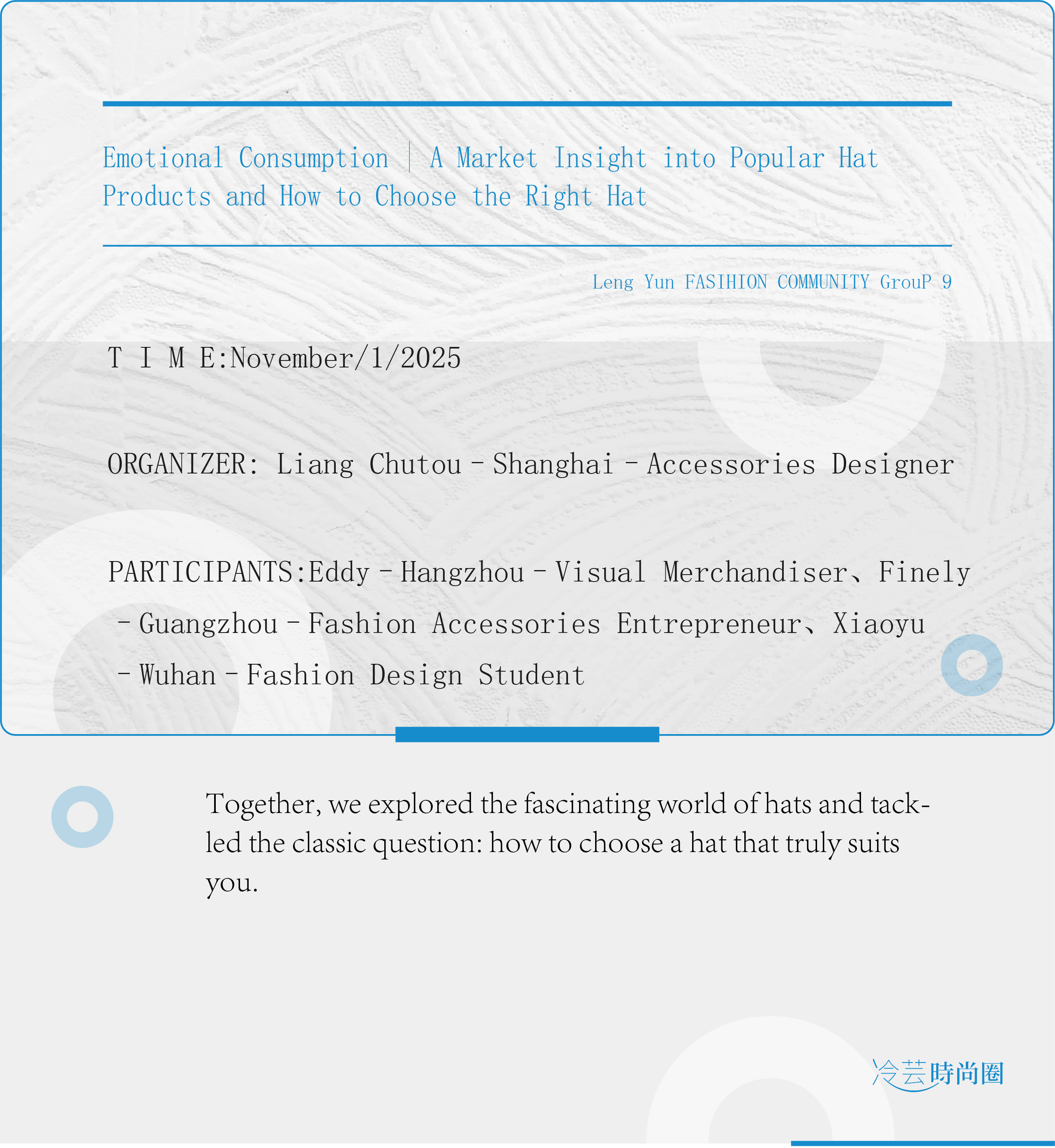

▼The following discussion in Leng Yun fashion community is a discussion and summary of industry issues. These shares are the crystallisation of collective wisdom. (They do not represent the personal views of Leng Yun). It is hoped that this method will benefit more industry professionals!

1. Original Intention and Deep Focus: Why I Chose Hats as a Niche Categor
The host studied Fashion and Apparel Design in the Honors Program at Wuhan Textile University. During her undergraduate years, she developed a strong interest in accessories courses. While in college, she designed a hat entirely by hand, showcased it in a runway show, and won an award—an experience that marked the beginning of her deep commitment to hats.
In 2017, the host landed her first job at the Shenzhen-based brand Marisfrolg, where she formally entered the world of hats and began learning through factory visits. In 2019, one of her hat designs became a best-seller, greatly boosting her confidence. Later, during a trip to Japan, she noticed how common hat-wearing was on the streets. After visiting many hat shops and seeing how refined and expensive the products were, she developed an even deeper interest in hat culture.
In 2021, she became the Head of Accessories Product at the brand CABBEEN, conducting in-depth research on baseball caps and planning the brand’s hat line with the vision of creating a “wall of hats” as a design goal.
In 2023, she joined a Hangzhou-based studio that originated as a hat brand. Their strict product standards made her realize for the first time that although hats are accessories, they are not supporting roles—they are the protagonists.
In 2024, she went to work in a hat factory in Guangzhou. She believed that to truly make good products, one must deeply understand craftsmanship and accumulate hands-on experience. Through continuous learning and practice, and in-depth research into hat materials and design concepts, she became increasingly坚定 in her passion and career choice.
She has always believed: hats are not supporting roles—they are protagonists that convey emotion and attitude.
2. Market Indicators: What Changes Are Taking Place in the Accessories Market?
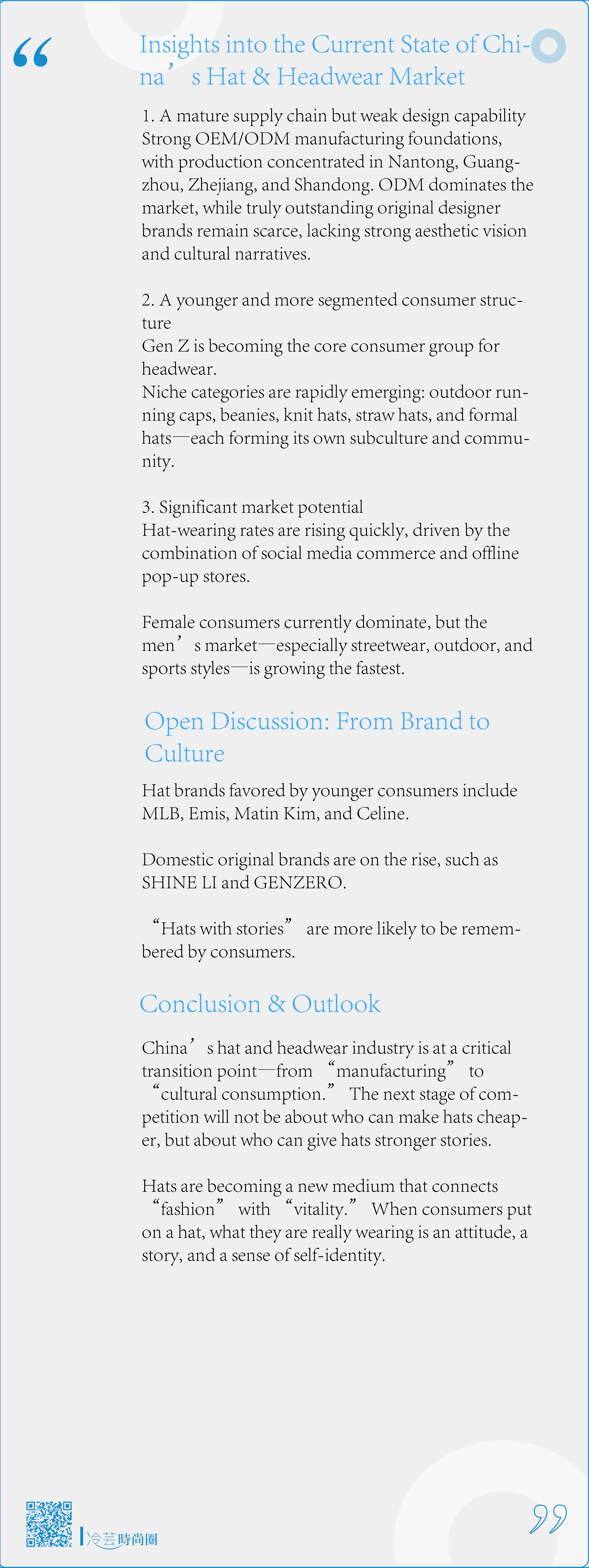
In recent years, China’s hat industry has shown significant growth, with the market size steadily expanding and consumers demanding increasingly personalized hat products.
As more accessories brands emerge, hats have shifted from purely functional items to products of emotional consumption. Although hats are accessories, they are no longer secondary.
Outstanding fashion brands share a common trait: they all place great importance on accessories, especially hats. Many brand founders themselves are avid hat wearers.
Styling and overall outfit coordination have become increasingly important. Hats have transformed into key elements of fashion styling. Some community members shared that after styling outfits on models, if a hat is missing, the look feels incomplete—and the same applies to everyday wear.
3. Local Design Observation: The Current State and Challenges of Chinese Hat Design
The volume of hats within domestic fashion brands has been steadily increasing. For example, a corduroy baseball cap that once had orders of only a few hundred units now reaches several thousand units, with continuous reorders.
However, the domestic market faces bottlenecks in design innovation. Despite strong demand, there are still relatively few professional hat designers and original brands, leading to high product homogenization.
Most Chinese fashion brands work under ODM models and lack dedicated hat R&D teams. Hats, scarves, and accessories are often handled by a single person, making it difficult to go deep in any one niche category.
Given the broad potential of the hat market, establishing a dedicated hat designer role could be a valuable step for apparel companies seeking better design outcomes.
Hat enthusiasts are also encouraged to visit the Fumei Hat Museum in Nantong. Its founder, Sun Jianhua (known as “Hat Brother”), is a leading figure and industry promoter who started from OEM manufacturing, built his own brand, founded a hat museum, and actively promoted hat culture and industry upgrading.
4. International Masters: Lessons from Top Global Hat Designers
Stephen Jones is a legendary milliner known for his bold and avant-garde designs. With over 40 years of experience, he has created iconic headpieces for brands such as Dior, COMME des GARÇONS, Jean Paul Gaultier, Vivienne Westwood, and Thierry Mugler. His collaboration with John Galliano during the Dior era firmly established his status in the fashion world.
An English designer with a strong “French” sensibility, Jones is deeply influenced by Parisian culture. His work spans film and music, including designs for Atonement and Madonna’s concert tours.
Irish millinery master Philip Treacy is often referred to as “the Picasso of the hat world.”
He once said: “I make hats because I love hats. They are mysterious objects, existing purely to embellish humanity and make people feel good—whether you are the observer or the wearer.”
Akio Hirata is a renowned Japanese hat designer, known as the “God of Hat Art.” He has designed hats for international brands such as ISSEY MIYAKE, COMME des GARÇONS, and Yohji Yamamoto, and has also served as the exclusive hat designer for Empress Michiko of Japan. In his runway shows, hats are clearly the protagonists—they have expressions.
The host firmly believes that hat-making is a lifelong career.0
A hat is not just a fashion item, but a craft and culture that can be passed down. Hat design integrates structural art, craftsmanship aesthetics, and cultural expression, placing high demands on a designer’s comprehensive abilities. This is why truly outstanding hat designers are always rare—it requires not only talent and aesthetic sensibility, but also time, hands-on experience, and cultural accumulation. For her, hats are a lifelong creative medium, carrying a designer’s understanding, craftsmanship, and spirit.
She also believes the market potential for hats is enormous.
Hats offer more than functional value—sun protection, warmth, face-shaping. More importantly, they provide emotional value and identity expression.
The moment someone puts on a hat, they are often shaping an attitude. Hats convey emotion, enhance confidence, and express individuality. In today’s era of consumption upgrading and personalized aesthetics, hats are moving from supporting roles to leading roles, from function to emotion, from accessories to symbols of lifestyle. Through her work, the host hopes to help more people rediscover hats.
By studying international masters, we can see that to design great hats, professional knowledge and aesthetic judgment are essential—but storytelling ability is equally important.

1. Pain Point Analysis: The “Top-Priority” Issues People Care About Most When Choosing Hats
Many people feel confused when choosing hats. The most common concerns are size-related: large head circumference, difficulty finding suitable hats, or worries that round or large faces will look bigger with hats.
In fact, choosing a hat is not about whether it “looks good,” but whether it “fits you.” Many people look bad in hats not because of their face shape, but because they chose the wrong hat style, brim, or proportions.
2. The Three-Step Hat Selection Method: Breaking the Myth of “I Don’t Suit Hats”
The core logic of choosing a hat is simple:
first, analyze face shape (to correct flaws);
second, consider head shape (to create dimension);
finally, match style and scenario (material).
Step 1: Choose Hat Styles Based on Face Shape to Precisely Modify Proportions
Step 2: Choose Details Based on Head Shape to Solve “Unstable Fit” and “Lack of Dimension”
Head shape mainly involves head circumference and forehead width. Choosing the right details helps avoid awkwardness:
For large head circumference (>58 cm): prioritize baseball caps or bucket hats with elastic bands or adjustable Velcro, or knit hats with flexible brims. Avoid stiff canvas or leather; choose soft wool or cotton-linen materials for better comfort.
For flat back of the head:
The key is to increase volume at the back. Choose styles with fuller crowns, such as:
① High-crown baseball caps (2–3 cm taller than standard);
② Berets worn slightly back to create space at the rear;
③ Loose, round-top bucket hats rather than tight-fitting ones.
How to Measure Head Circumference (Two Steps):
1. Prepare a soft measuring tape (or string + ruler).
2. Measure around the head 2 cm above the eyebrows, passing the most prominent point at the back of the head. Keep it snug but not tight.
Measure twice and take the larger value for accuracy. Include hair volume.
Tips:
The tape should touch the head without tightening.
For comfort and stability, allow about 1 cm extra.
Common hat size references in China:
Small: <54 cm
Standard: 54–58 cm
Large: >58 cm
Incorrect sizing affects both comfort and appearance. Too tight makes the head look larger; too loose slips easily. For caps, the right size = smaller-looking face + better shape.
For people with large head circumferences, the host suggests sizing hats properly—offering S / M / L or 56 / 58 / 60 cm options. She also incorporates adjustable structures (metal buckles, elastic, ties) and high-resilience sweatbands.
A good hat should not only look good, but fit “just right”—combining function, face-shaping, and aesthetics.
Step 3: Match Hats to Daily Style—Hats Are an Extension of Your Outfit
For casual styles (T-shirts, jeans, hoodies): baseball caps, bucket hats, and knit hats are recommended. Baseball caps with hoodies look youthful, bucket hats with denim feel relaxed, and knit hats with down jackets are warm and versatile.
Choose brim widths of 8–10 cm or more. Curved brims generally create a better “face-wrapping” effect than flat brims, such as MLB’s CP77 style.
For knit hats, avoid overly tight styles. Leave some space for better proportions. Hats can help frame the face—especially for fuller faces, using bangs and hat placement together works well.
Community Question: What’s the Difference Between Beanies and Knit Hats?
The host explained that they essentially refer to the same category. Both are made using knitting techniques. “Beanie” emphasizes warmth and cold protection, while “knit hat” refers more broadly to the manufacturing method and includes various styles and thicknesses.
New styles such as ear-flap hats, faux-fur hats, and cloche-inspired knit hats all belong to the knit-hat category.
Four Key Factors for Beanies to Flatter the Face:
1. Structure (Crown & Space): The crown shape (pointed, flat, roomy, or tight) affects vertical lines. Pointed or higher crowns elongate round faces; flatter styles balance long faces.
2. Hat Opening (New Hairline): The position and shape of the opening redefine the upper face. Folded brims can add width near the temples, benefiting diamond-shaped faces.
3. Material & Knit Density (Visual Weight): Chunky knits add volume and suit slimmer faces; fine knits look lighter and suit larger head circumferences.
4. Details & Color (Visual Focus): Pom-poms, folds, and bold colors draw attention. A top pom-pom lifts the gaze upward, helping elongate round faces.
PS:Translation is done by AI.
文字整理:周麟茜
文字编辑:周麟茜
美术编辑:李宁
 CHINA FASHION BUSINESS
Leave a comment